

Venice. Part 2.
A look into the Giardini pavilions from subtle to cryptic to shamelessly audacious.

So far, Austria, arguably the flashiest pavilion, has gotten the most attention during a Biennale that invites to look for the subtle. After three unsuccessful tries at seeing it myself, I gave up. I noticed an uptake in concrete poetry. I saw it in the deconstructed words of the Belgian Pavilion, the throat-screaming manifestos performed in the Dutch Pavilion, and Yto Barrada’s (Gen X, Franco-Morrocan) onomatopoeia for the French Pavilion. Everywhere, it seems, language is giving in.
With the premise of In Minor Keys, I was surprised that I haven’t heard a single comment on the Swiss Pavilion. The Unfinished Business of Living Together is an understated documentation of institutional anti-queer violence and discrimination in Switzerland. While I haven’t made up my mind yet on whether some parts of the exhibition are bland or just dry Swiss humor, I appreciate how it addresses the sensationalization of queer communities while refusing to be sensationalist itself.
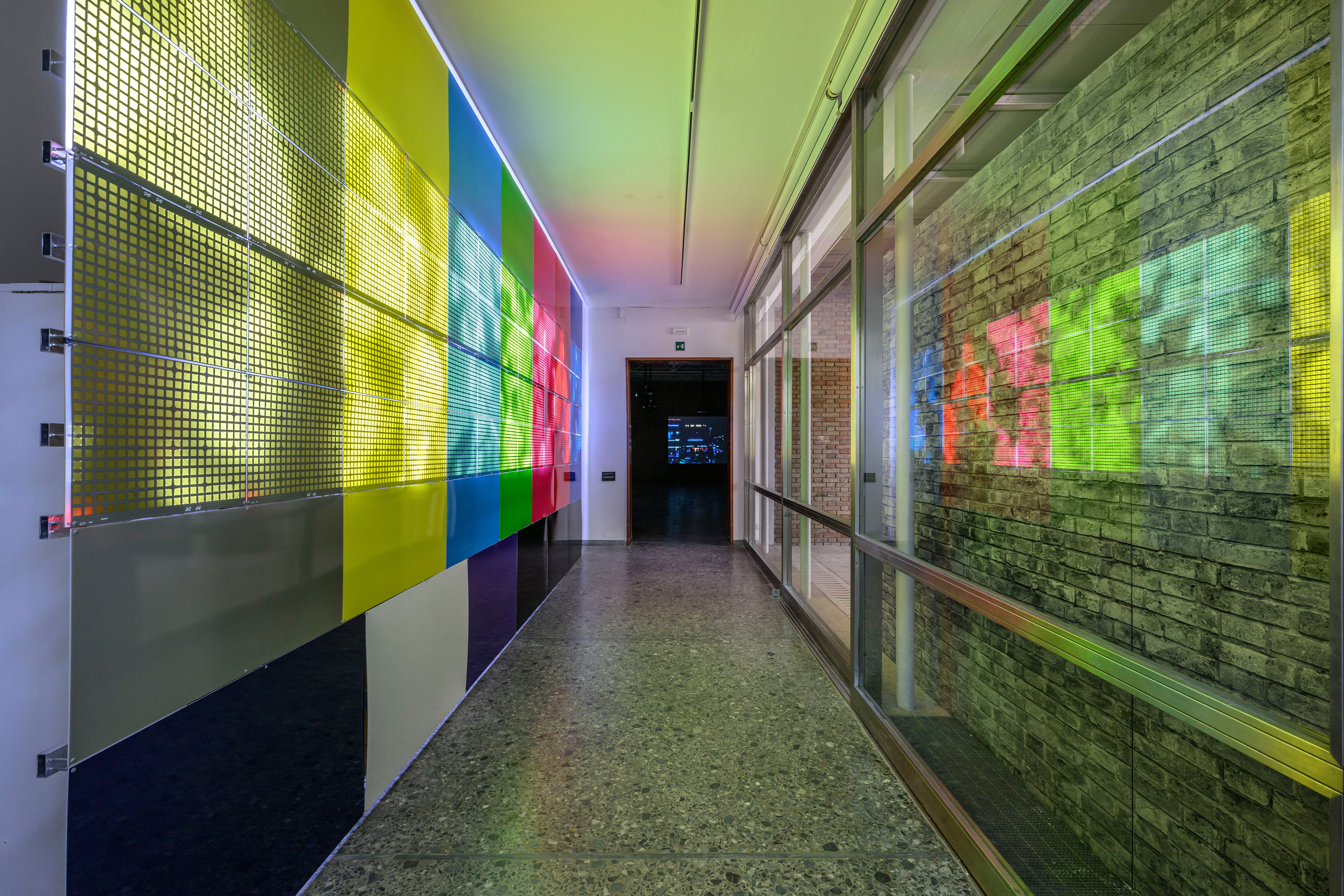
Club music comes from inside a sterile, white-walled labyrinth. The holes in a door window form a medical cross. The volume suggests that there’s a crowd doing its own thing, not begging for attention. I passed an LED wall and entered a curtain-lined screening hall playing archival video snippets from documentaries, television reports, and talk shows along with artistic interventions. There’s a television broadcasts discussing the “problem of homosexuality”, officials brushing off the AIDS crisis, a report on the municipality Lucerne cutting down a park to get rid of cruisers. I saw black and white demos of spyware cameras which were hard to put in a timeline but ironically echo Meta’s and Rayban’s new pervert glasses. What is the panopticon if not the creep as an institution?
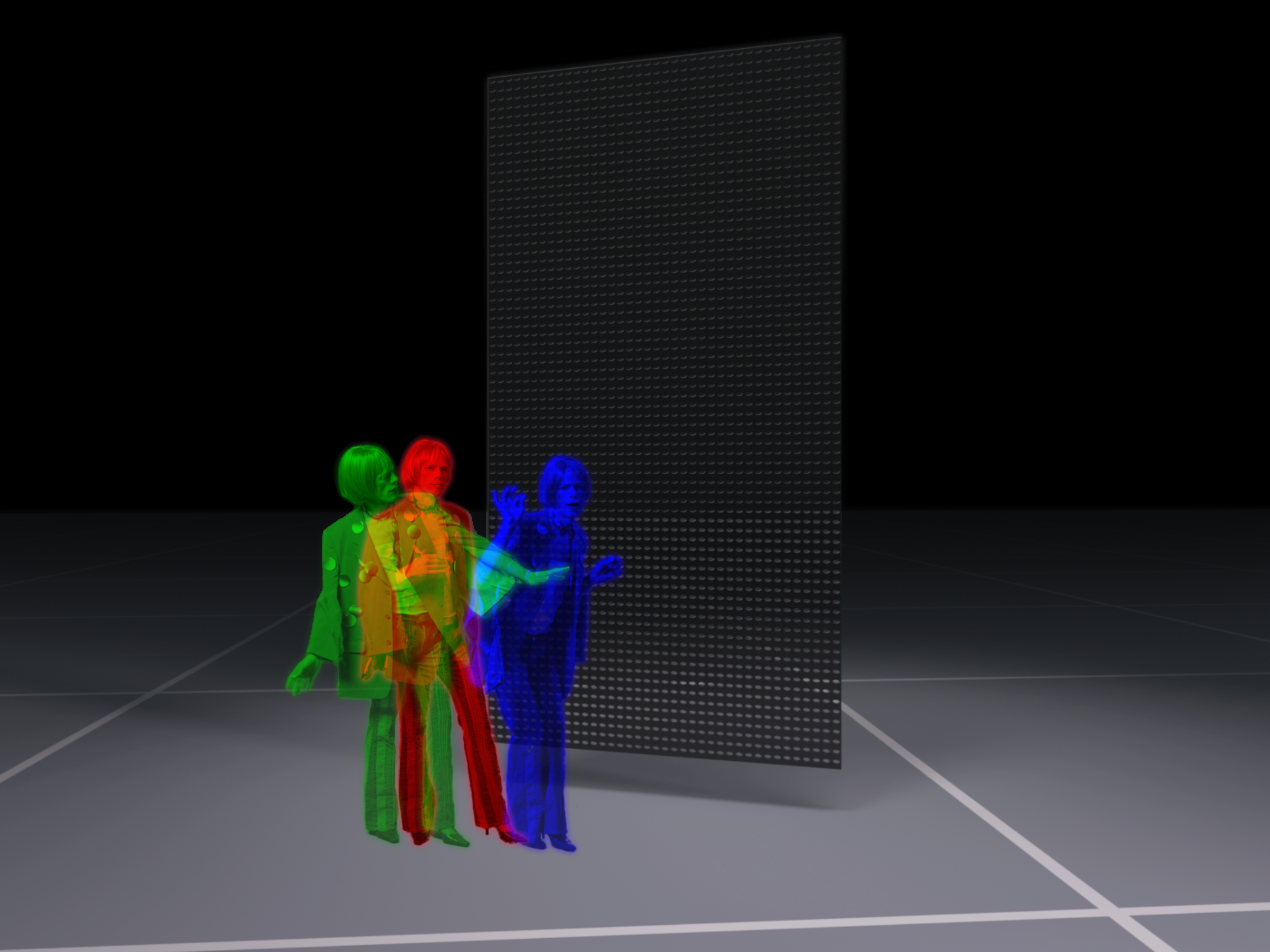
In one of the artistic interventions, a character appeared in a futuristic Matrix. He dissolved into RGB color versions of himself, proclaiming that those colors are just a base. The spectrum is so much more than that.
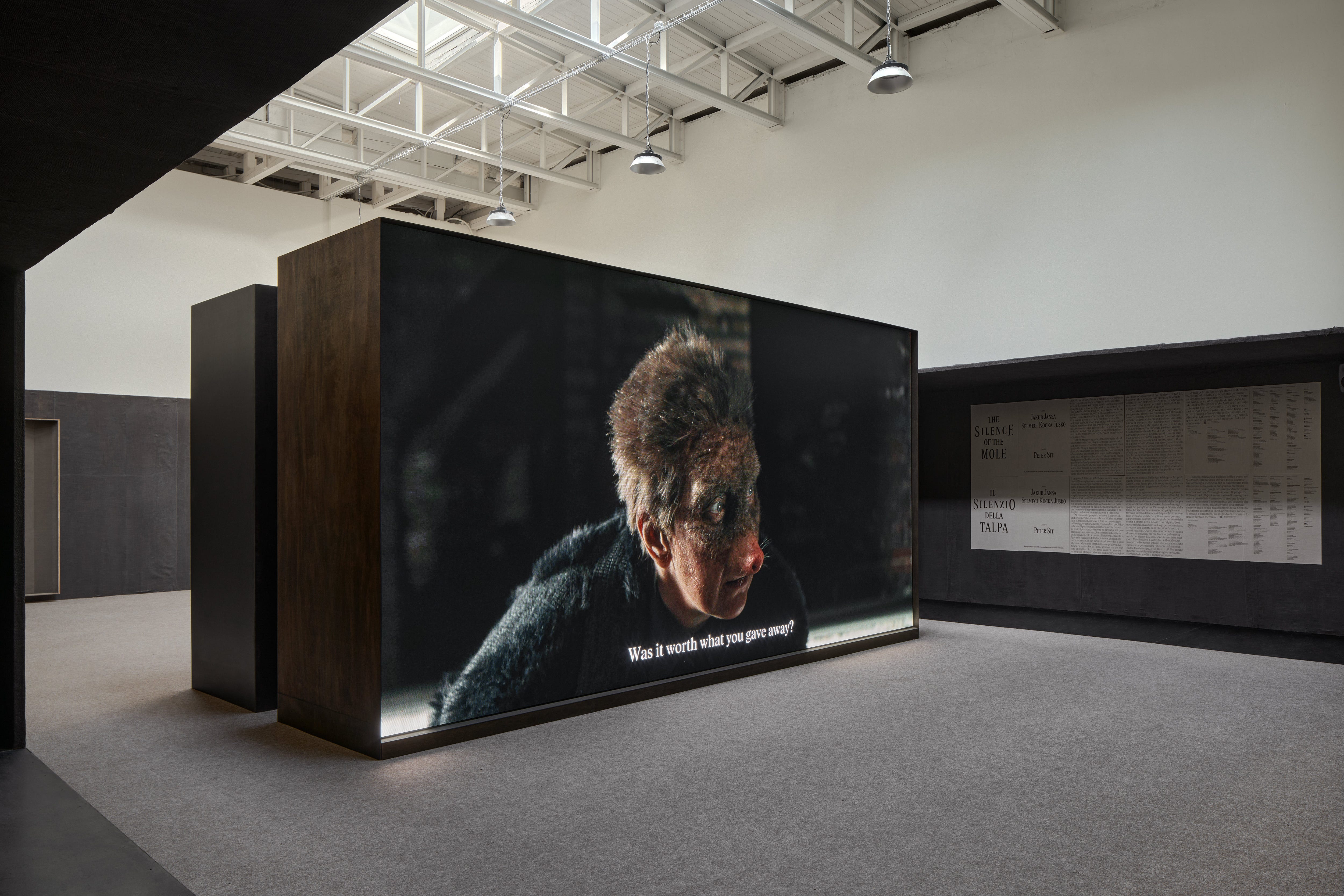
At the Czech and Slovak Pavilion, The Silence of the Mole follows the beloved entertainer Mr. M. who speaks in Dr. Seussian rhymes and is selected to represent the establishment while losing himself in the process. While Jakub Jansa (Millennial, Czech) handled the cinematography, the artist duo SelmeciKocka Jusko (both Millennial, Slovak) contributed sculptural objects… Objects I’m crashing out over as I’m writing because I’m seeing them for the very first time browsing through the press kit. I swear they weren’t anywhere to be found when I was at the pavilion and yet the installation pics gaslights me into believing otherwise. All I saw was one delicate object positioned right at the entrance of the pavilion: A box with abstracted cones reminiscent of ears. An invitation to tune in.
It’s easy to appreciate the cinematography. My favorite scene was the darkened silhouettes of the establishment against the saturated dusk. Their gestured secrecy, their visual obscurity and mighty monumentality stand against a meager Mr. M. who they lean over to, looking into the white box that makes up his world.
Jakub knows how to stir confusion in exciting ways. I was excited to see how he’d do it this time. I watched the film. And then once more after the loop. I watched it again when I returned three months later. After three watches, all I had were question marks. Not let me contemplate that… but huh?!? question marks. I realized that the Czech and Slovak Pavilion was, essentially … Onika Burgers.
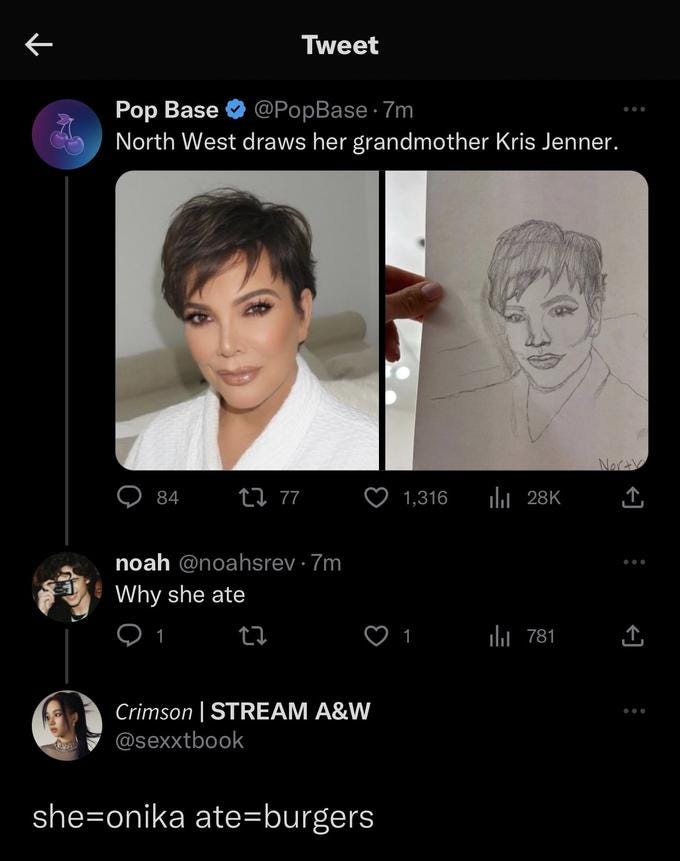
Onika Burgers is a meme that originated on Twitter as a reply to a Pop Base thread. The reply aims at ragebaiting Niki fans by declaring that Niki Minaj — whose government name is Onika Tanya Maraj-Petty — is obese because she eats burgers. Apart from the reply being totally unrelated to the original post, its formulaic approach isn’t thought through: instead of ending up with “Onika eats burgers”, we get a confusing “onika burgers”.
In the Pavilion, I felt that same confusion as when I first stumbled across Onika Burgers. An alienated confusion like I was expected to decode obscure variables to calculate a correct result. As if the film didn’t want me to tune in to the world it built and just puzzle the right pieces together.
This film felt so different from those I got to know Jakub through. When I heard Jakub’s protagonist Celeriac in SHAME TO PRIDE, CLUB OF OPPORTUNITIES, EPISODE VII (2021) ramble about being vegetables in a salad system, I didn’t need certainty on whether he’s a clairvoyant prophet, a rational scientist, a corrupt politician, or a crackhead from the subway. The ambiguity of his character’s standing, his shifting position throughout that video series, is what made the work so alluring. And neither did I need to know whether his speech alluded to Czech politics, a specific event or Western society as a whole. The surreal, feverish set-up and the potential insanity of Jakub’s characters is precisely what mirrors our hallucinatory reality without having to spell out any parallels.
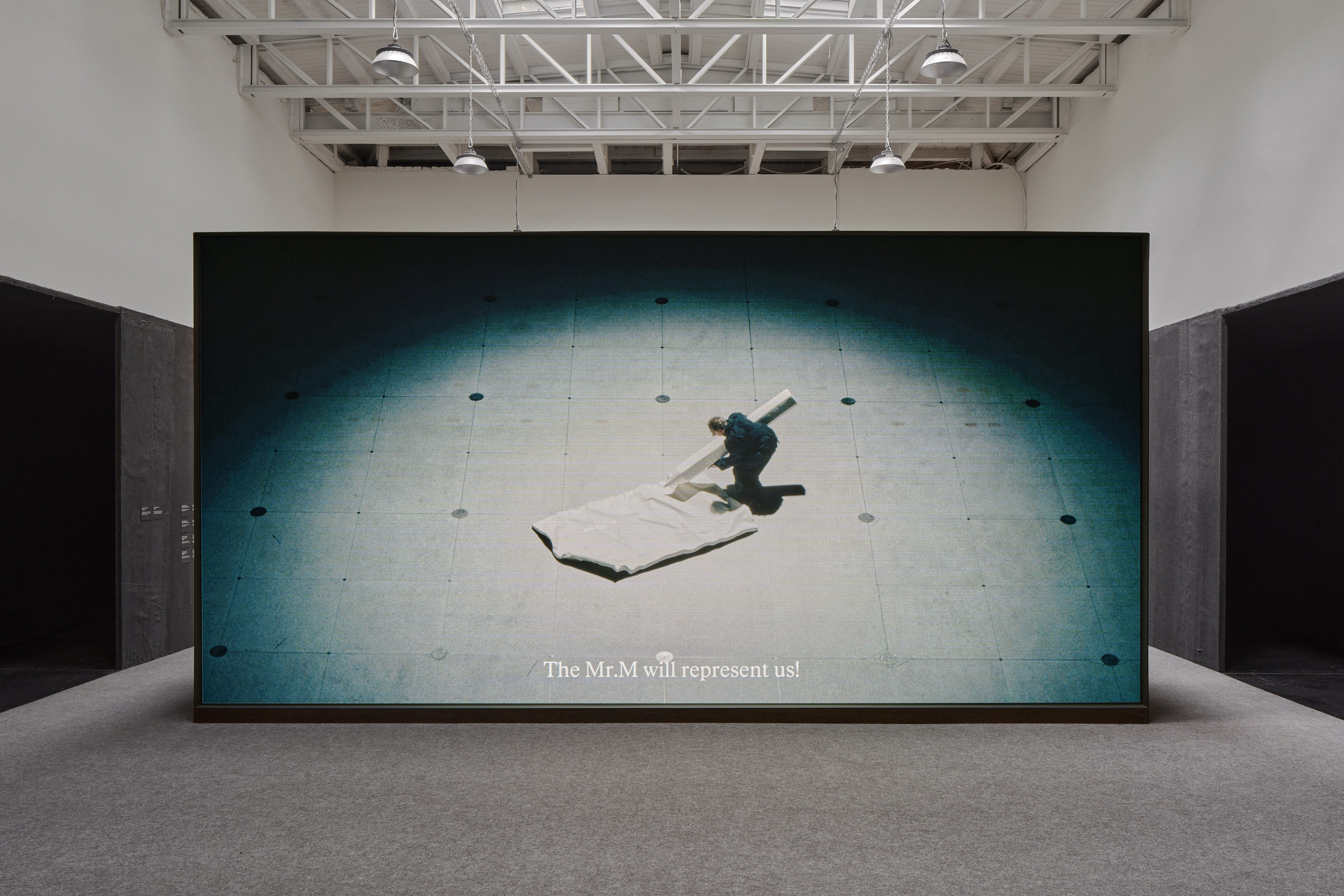
After each loop staring at Mr. M., I kept watching like a parent who has never seen a meme before, asking stuff like Who is that? Do you know them? Did you take that picture? Do you know them from school?
Like what was that frog on one of Mr. M.’s instruments referring to? Who exactly is that establishment that chose him? Why is Mr. M. sniffing that woman’s hair on the boat? Who is that audience he’s performing for on that small island? Is it the Venice art people? Another establishment? An Epstein island reference?! Is he really killing everyone and himself in a kamikaze move sinking that damn island?! Why would he do that???
I interviewed Jakub last year. I knew his references. I knew his Onika. And even with all that background I was lost. It’s like Jakub imposed a language of censorship upon his own work that required those in the know to decode his symbolism instead of sitting with its illegibility.
I then went on to the propaganda pavilion. Russia? No, we already talked about that one en masse. I’m actually referring to the Japanese pavilion this year. Artist Ei Arakawa-Nash (Gen X, Japanese-US-American) and his1 partner became parents during COVID, which prompted him to think about child rearing through his artistic practice. But this exhibition is not about the systemic struggles of queer parenthood. Grass Babies, Moon Babies is all about KEEP CALM and make children.
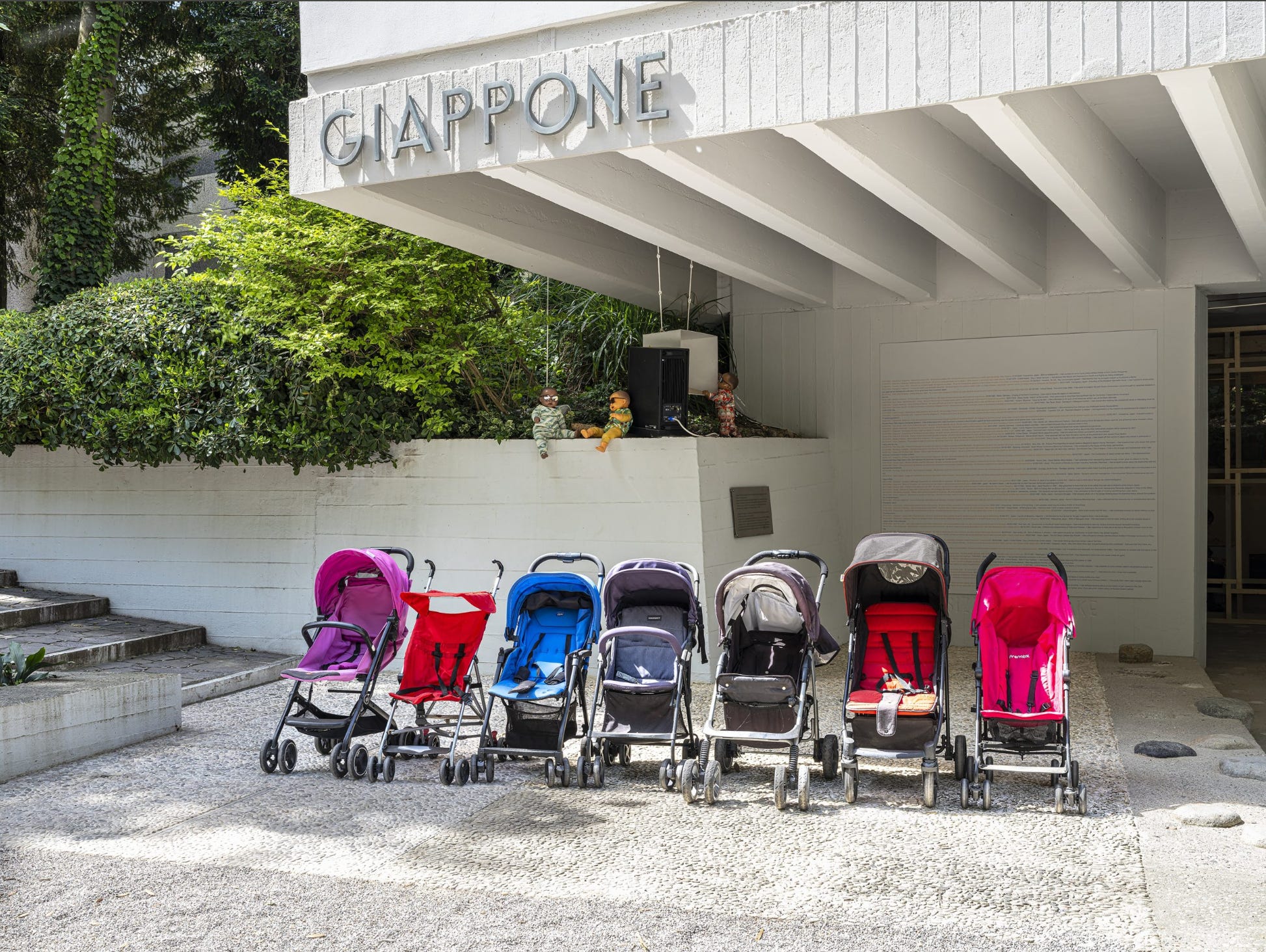
Baby bottles dangle from the pavilion entrance like a curtain. There’s sunnies-wearing baby dolls all over the garden, on the roof and inside the building, some even hanging from ropes. Isamu Noguchi’s (1904–1988, US-American) beautiful sculpture Radio Nurse (1937) stands in an arrangement of painted, abstract cardboard diapers. In the courtyard underneath the pavilion, visitors may become participants. If they wish, they are assigned a doll which they are to carry upstairs. At the changing table, they open the diaper to scan a QR code with information on their assigned baby. After, they must return the baby to the staff downstairs.
There’s so much wrong with this whole concept, I don’t even know where to start. The waiting line is marked with a hand-written “Baby Holding Experience” sign like it’s an amusement park activity. The other issue is that this participatory gesture suggests a real experience. It suggests that one gets to experience the weight of a living being in your arms, a sense of what it’s like to take care of a child while pretending to convey that parents can’t choose their children. But the exhibition is far from simulating actual parenthood. It’s nothing but fatherhood cosplay: You choose if you want to hang out with the kid, you carry it around for a bit, get admiring looks for how responsible and caring — perhaps even attractive — you look, you skip the whole stinking and crying part, and then you give it back to its real caretakers once you’re over with it.
And probably the worst part of it all was seeing couples taking pictures as they were holding those babies. Observing themselves and each other in the mirror on the way upstairs with their precious cargo and exchanging a “You know what: Maybe we should get one, too!” look like those people who impulse-bought puppies during COVID.
Visitors are presented a hollowed-out simulacrum of care work that lacks commitment. There’s no irony. No cheek-in-tongue subversion. No camp like at Maja Malou Lyse’s (Millennial, Danish) exhibition Things to Come at the Danish Pavilion which plays with pornography as the solution to male infertility.
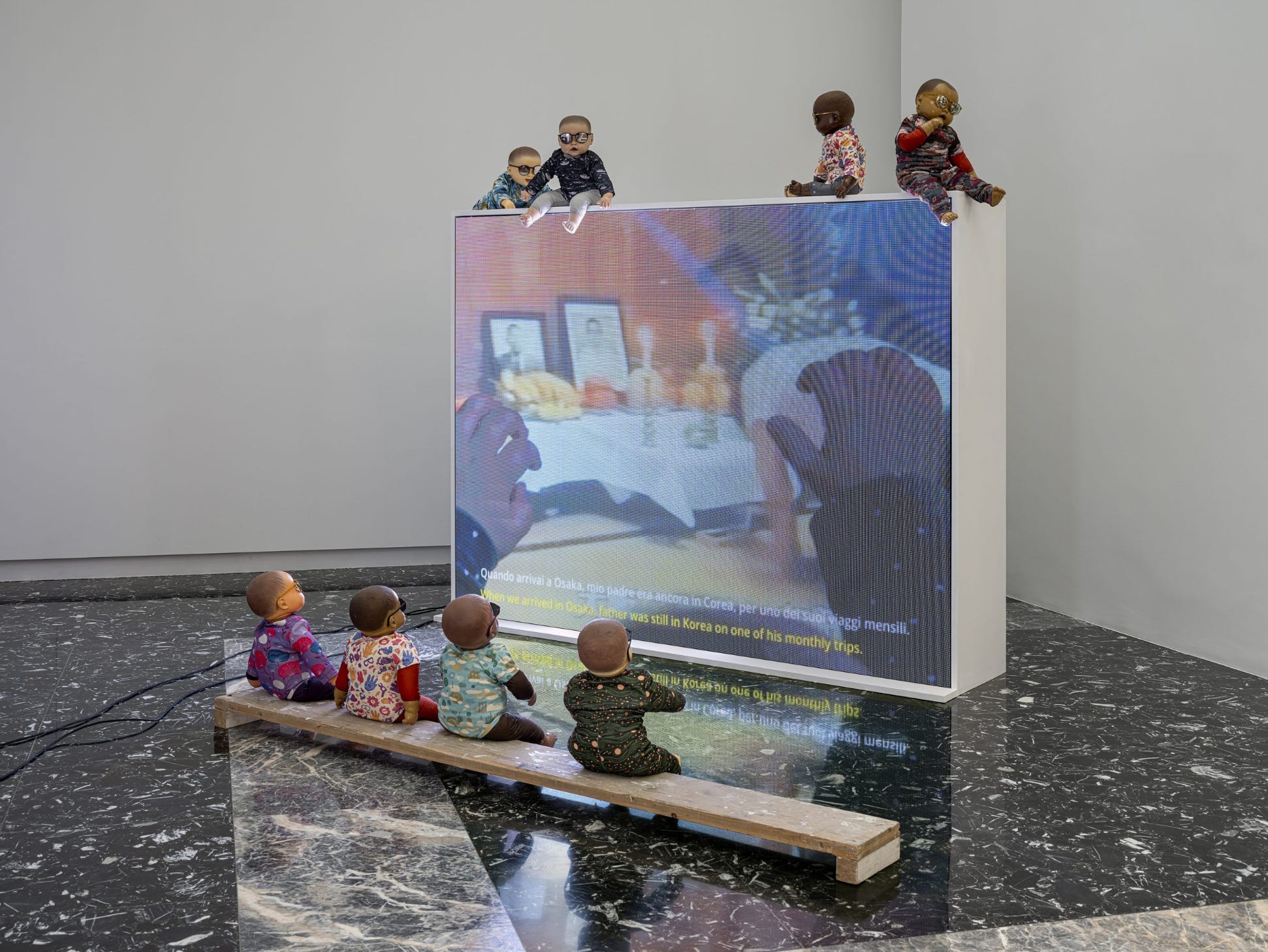
And now let’s get to my final straw. The exhibition leads with a conveniently chosen citation of a four-page International Monetary Fund (IMF) report from 2025 titled “The Debate over Falling Fertility” that outlines how global fertility rates are continuously plummeting. I looked into the report and I don’t know about you guys, but quoting demographic research published by a financial institution that has a remarkable controversy track record, was conducted by three men citing no sources, mentioning women at only one instance, and leading with arguments like these comes across as rather suspicious:
“A nation’s slow or negative population growth relative to other countries may translate into less military might and political clout on the world stage. For example, some historians attribute France’s 1871 defeat in the Franco-Prussian War to the low fertility and slow rate of population growth that stemmed from early and widespread use of contraception among married couples in France.” — The Debate over Falling Fertility, IMF report from June 2025, p. 52
What a cool and absolutely not questionable argument. I’m sure the institution commissioning such a report has no ties to military dictatorships whatsoever!
To speak of demographic development is to speak about giving birth which includes speaking about women and people with uteri. As a man (even if he is queer), making a case for having more kids while women bear all the risks and consequences is kinda a fucked up thing to do, don’t you think?
How about after centuries of institutionalized patriarchal violence, women (which neither the article, nor the exhibition sufficiently addresses) are granted autonomy over their own bodies on a global scale which — I know, crazy thought incoming — might result in them choosing to live childfree? How about women fighting to preserve that new freedom amid their rights regressing worldwide, as a recent UN 2026 report concludes? How about right next door in South Korea, women have championed the 4B movement out of desperation in a brutally patriarchal society that demands more children while making their conditions impossible to sustain?
Ei deciding to become a parent is a good for HIM situation, but to pretend like child rearing is merely a personal choice and not a set of structural conditions is a level of audacity I would not have expected in 2026.
61st International Art Exhibition of La Biennale di Venezia, until November 22, 2026.
La Biennale di Venezia — Giardini della Biennale
Calle Giazzo
30122 Castello, Venice
Website
Instagram: @labiennale
See you soon!!!
Jennifer
The Gen Z Art Critic
Although the Press Material of the Japanese Pavilion refers to the artist with they/them pronouns, Ei’s own website uses he/him.